The drive south is its own tradition. Four people in a car belonging to one of them, a shared fuel budget, and a schedule built around arriving before dark and then not arriving before dark.
Most of these trips are uneventful. The ones that are not go wrong in a specific way, because a student crash in Florida combines the two things that complicate a claim most: an out-of-state driver and a short clock nobody mentioned.
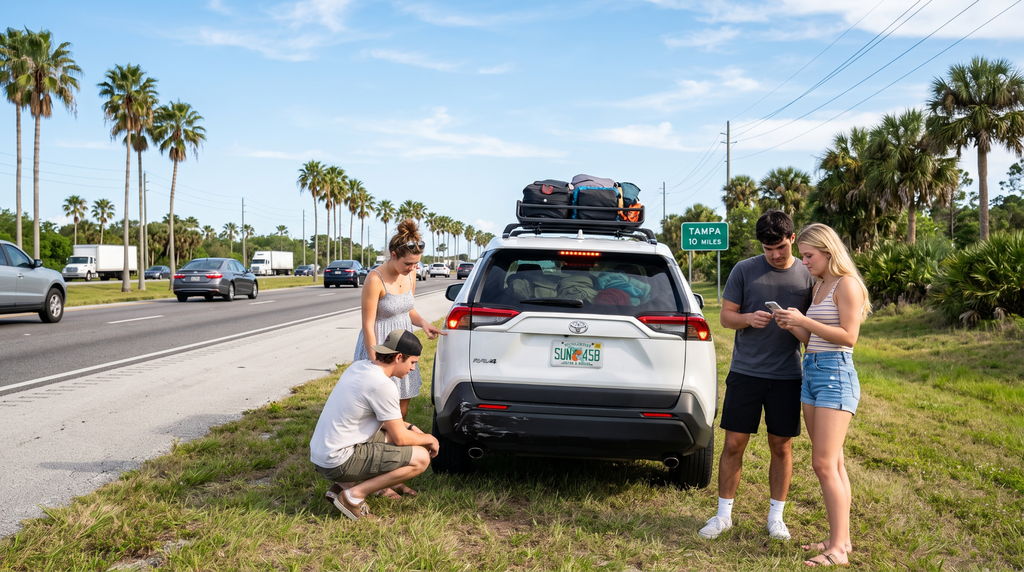
This is the practical version of what to do, written for someone who is a thousand miles from home and does not want to call their parents first.
The Fourteen Day Rule Is the Thing to Know
If you remember one item from this article, make it this one.
Florida requires treatment within two weeks
Florida runs a no-fault insurance system. Personal Injury Protection pays 80 percent of reasonable medical expenses and 60 percent of lost gross income, up to $10,000, regardless of who caused the crash.
The catch is that initial services and care must be received within fourteen days of the accident. Miss that window and the benefit is generally gone, no matter how legitimate the injury.
This is exactly how student claims fail
The pattern is predictable. The crash happens on a Tuesday, everyone feels basically fine, the trip continues, the drive home takes two days, classes resume, and the neck pain that started on day four gets an appointment three weeks later.
By then the fourteen days have passed. Get checked in Florida, or at home within the window. The location does not matter. The date does.
The emergency determination changes the amount
Full benefits up to $10,000 require a qualifying provider to determine that you had an emergency medical condition. Without that, reimbursement is capped at $2,500.
Whose Insurance Even Applies
This is where student trips get genuinely confusing.
The car is probably not yours
If you are driving a friend’s car, or a parent’s, the applicable coverage usually follows the vehicle rather than the driver. The owner’s policy is generally the starting point, which means a conversation with the owner has to happen early.
Out-of-state policies meeting Florida rules
A vehicle registered and insured outside Florida is governed by its home state policy, though many policies adjust coverage to meet the requirements of the state you are driving in. Whether PIP-equivalent benefits apply to you can turn on that language.
Everyone in the car is a claimant
Four passengers injured in one vehicle are four claims against the same coverage. Each person needs their own treatment record. Assuming the driver “handles it” leaves three people undocumented.
What to Do at the Scene
Being organized for ten minutes is worth more than everything you do afterward.
Call police and get a report
Insist on a report even for a minor impact. Florida crash reports are obtained through the state’s traffic crash report system, and that document becomes the spine of the file.
Photograph more than the damage
Capture both vehicles, the position on the road, the other driver’s license and insurance card, and the license plate. Photograph the other driver’s license specifically, because the issuing state determines which policy rules apply.
Get witness contacts immediately
Around Tampa in March, most witnesses are visitors. They will be in another state within days and unreachable afterward.
Say less than feels polite
Apologizing is reflexive and expensive. Florida changed its comparative fault rule in 2023, and a claimant found greater than 50 percent at fault for their own harm now recovers nothing. Before that change a claimant could recover a reduced amount at any fault level.
The Things Students Specifically Get Wrong
A few patterns repeat often enough to name.
Using student health services without connecting the cause
Campus health is a reasonable place to be seen. The record has to state that the symptoms follow a motor vehicle accident on a specific date, or it does not function as evidence of causation.
Posting the trip
Photographs from the rest of the vacation are read literally by adjusters. A beach picture taken on a good afternoon becomes proof of unimpaired function.
Assuming a minor impact means a minor injury
Low-speed collisions produce real soft tissue injuries, and symptoms commonly appear on day two or three. The fourteen day rule does not wait for you to be sure.
According to Shaun M. Serelson, a Partner and Managing Attorney at RTRLAW who handles personal injury matters before suit is filed, notes that out-of-state claimants lose Florida benefits more often than residents for a structural reason rather than a legal one, since they leave the state before symptoms appear and the treatment window closes while they are traveling. Students injured on Florida trips often reach out from campus since the first step is understanding legal rights after a car accident.
Before You Drive Down
Know whose policy covers the car and whether it extends to everyone driving. Put the owner’s insurance details in your phone rather than the glovebox.
Check the driving safety guidance for the state, particularly if you are not used to interstate driving in heavy tourist traffic. And agree in advance who drives which legs, because the most preventable version of this whole article is a tired driver at hour eleven.